Hop by Hop: A Realistic Guide to Microservices for Teams Without Netflix's Budget
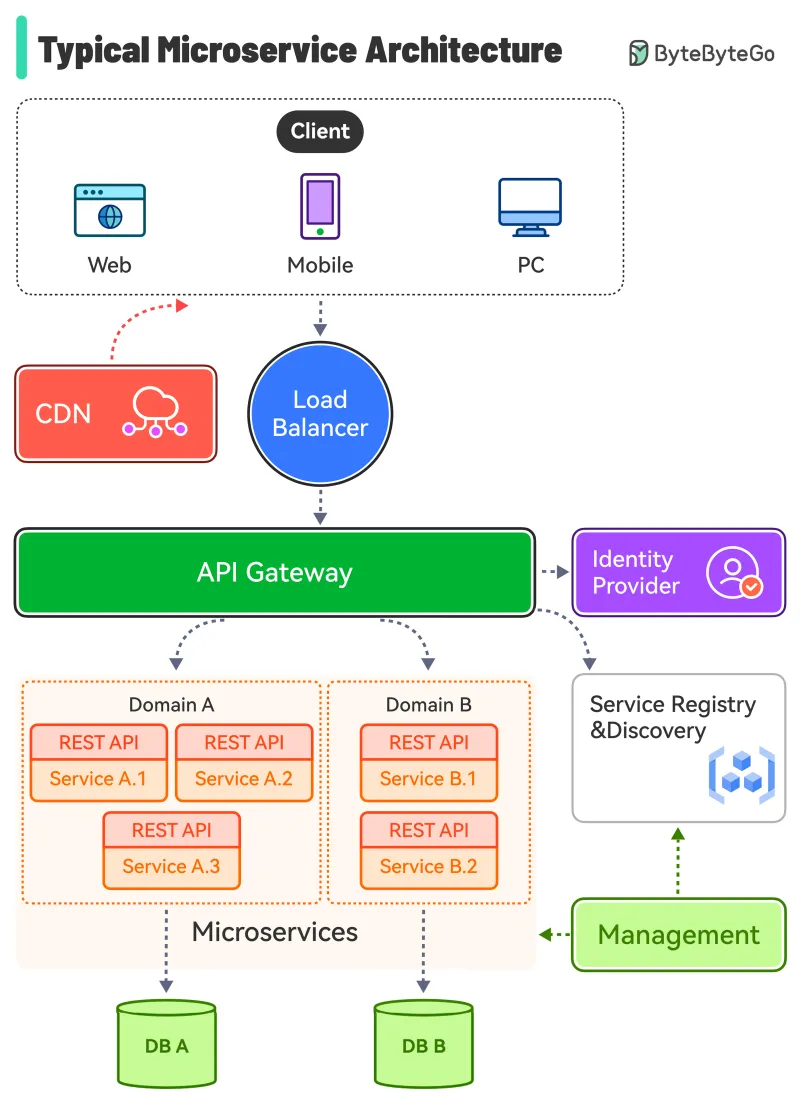
Photo: microservices architecture diagram server network infrastructure mid-size office team, via assets.bytebytego.com
Every developer who's sat through a tech conference in the last decade has heard some version of the same story: company had a big monolith, company broke it into microservices, company achieved infinite scale and engineering bliss. The case studies are compelling. The architecture diagrams look clean. And then you go back to your office, look at your twelve-person engineering team and your very real AWS bill, and wonder if any of that actually applies to you.
Here at RibbitSol, we spend a lot of time thinking about how mid-market companies — the ones that aren't startups anymore but definitely aren't Netflix — can make smart infrastructure decisions without betting the whole pond on a single architectural shift. Microservices done right can genuinely transform how a mid-sized team builds and ships software. Microservices done wrong can be an expensive, complicated disaster that takes years to untangle.
The difference usually comes down to how you make the leap.
Why the Big Tech Playbook Doesn't Translate
Let's be honest about the gap. When Amazon or Google talks about microservices, they're describing systems that evolved over years with dedicated platform engineering teams, internal developer portals, and massive operational budgets. They have the people to manage service meshes, write internal SDKs, and build the tooling that makes hundreds of independent services manageable.
A company with 15 to 150 engineers doesn't have that. And trying to copy the architecture without the organizational infrastructure to support it is one of the most common — and costly — mistakes mid-market engineering teams make.
"The failure mode I see most often is teams that go all-in on microservices because it seemed like the right thing to do architecturally, without thinking through the operational complexity they were signing up for," says Rachel Torres, a software architect who's led infrastructure transitions at several mid-sized SaaS companies. "Suddenly they've got 30 services, no clear ownership model, distributed tracing they don't fully understand, and debugging a production issue takes three times as long as it used to."
The goal isn't to avoid microservices. It's to adopt them incrementally and intentionally.
The Strangler Fig Strategy (Or: Don't Burn the Monolith Down)
The smartest approach most mid-market teams can take borrows a concept from Martin Fowler's well-known strangler fig pattern — the idea that you extract services from your existing monolith gradually, letting new services take over specific functionality while the core system stays intact.
This is less dramatic than a full rewrite, but it's dramatically safer. You identify a bounded piece of functionality — billing, notifications, user authentication — that has clear inputs and outputs and relatively limited coupling to the rest of the system. You extract it, build the new service, route traffic to it, and verify it works. Then you repeat the process.
The monolith doesn't disappear overnight. But over time, it does get smaller, and your team builds operational confidence with distributed systems at a pace that matches their actual capacity.
For a mid-market company, this approach has a few specific advantages. You're not betting your entire engineering roadmap on a migration. You can prioritize extraction based on business value — pulling out the services where independent scaling or deployment would actually move the needle. And your team learns the operational patterns of microservices (service discovery, inter-service communication, independent deployments) in a controlled, lower-stakes way.
The Real Cost Conversation
Microservices can save money at scale. They can also cost significantly more than a well-maintained monolith for teams that aren't at that scale yet. This is a conversation that doesn't happen enough.
When you break a monolith into services, your infrastructure bill doesn't just increase — it also gets more complex. You're now running multiple services, potentially across multiple containers or functions, with networking costs between them, separate logging and monitoring for each, and more moving parts to keep updated and secured.
"The compute costs are often the least of it," says James Park, a cloud infrastructure consultant who works primarily with Series B and C companies. "It's the observability tooling, the service mesh overhead, the time your engineers spend on infrastructure instead of product work. Those costs are real and they're not always visible in the initial analysis."
Before committing to a microservices migration, teams should build an honest model of what the operational costs look like — not just at the end state, but throughout the transition. A phased approach helps here too, since you're adding costs incrementally rather than all at once.
The flip side is also true: there are real, quantifiable benefits that justify those costs for the right services. Independent deployment means your billing team can ship fixes without waiting for a full monolith release. Independent scaling means you're not provisioning your entire application for peak load on one component. If you can point to specific services where these benefits have clear dollar values, the business case becomes much easier to make.
What to Extract First
Not all parts of a monolith are equally good candidates for extraction. The services that tend to deliver the most value earliest share a few characteristics.
They have well-defined boundaries. If you can describe exactly what data a service owns and exactly what it exposes to the rest of the system, extraction is much cleaner. Services with fuzzy ownership or heavy data sharing with other parts of the monolith are much harder.
They have independent scaling needs. If your email notification system needs to handle 10x traffic spikes during marketing campaigns while the rest of your application runs at normal load, that's a strong argument for making it its own service.
They have independent deployment cadences. If your payments team wants to ship multiple times a day but your core product team ships weekly, separating those concerns into independent services removes a constant source of friction.
Conversely, services that are deeply entangled with your data model, that share database tables with half your application, or that don't have clear ownership within your team structure are usually better left in the monolith until you've built more operational maturity.
Lessons from Companies That Got It Right
A regional healthcare software company with about 60 engineers spent three years gradually extracting services from a decade-old Rails monolith. They started with their notification system — emails, SMS alerts, in-app messages — because it had the clearest boundaries and the most obvious scaling needs. That extraction went well, and they built confidence. They then tackled their reporting pipeline, which was causing performance problems for the whole application. By the time they got to their more complex core services, they had established patterns, tooling, and operational habits that made each subsequent extraction smoother.
The key, according to their engineering lead, was resisting the pressure to accelerate the timeline. "We could have moved faster. We chose not to. Every service we extracted taught us something that made the next one easier."
The Organizational Side Nobody Warns You About
Architecture and organization are deeply connected. Conway's Law — the observation that systems tend to mirror the communication structures of the teams that build them — is more than a fun aphorism. It's a real constraint.
Before you split your services, make sure you've thought about who owns each one. Microservices without clear ownership are a recipe for confusion. If two teams are both responsible for a service, it often means neither team is truly responsible for it.
For mid-market companies, this might mean being more conservative about how many services you extract. Fewer, well-owned services will almost always outperform a larger number of orphaned ones.
Start Small, Hop Smart
Microservices aren't magic, and they're not mandatory. For a lot of mid-market companies, a modular monolith — a single deployable application with well-organized internal boundaries — is actually the right answer, at least for now.
But when the business case is real and the team is ready, incremental extraction done thoughtfully is absolutely achievable without a massive engineering org. The companies that succeed are the ones that treat it as a journey rather than a destination — hopping from lily pad to lily pad instead of trying to cross the whole pond in one leap.
At RibbitSol, that's basically our whole philosophy. Smarter software, one hop at a time.